Public promises are made to vanish. A commitment spoken at a press conference, posted to a campaign page, or printed in a press release rarely has an owner, a deadline, or follow-up, and by the time anyone checks, the original page is often gone. I built SF Promises to fix that: an agentic pipeline that finds the official record of what San Francisco's leaders and institutions promised, archives it locally, and re-checks each commitment against later official evidence to produce a verifiable verdict.
My core design constraint was simple: every claim ships with a checkable source.
Winner: "Best Use Of Keenable" at the Archil Hackathon
I built SF Promises in one night during the Archil "Agents need solid ground" Hackathon on November 10, 2026. Out of 33 projects from 46 builders, it won "Best Use Of Keenable" (1 of 5 honors awarded) for temporal source retrieval and deterministic verification.
The Pipeline: Four Stages to a Sourced Verdict
I designed the pipeline around one rule: every claim traces to a saved source. Each verdict requires a verbatim quote, an allowlisted domain, a saved file, and a matching SHA-256 hash:
1. Fetch and archive official sources
The pipeline fetches the official source (city publications, agency releases, or official accounts) and saves a local copy, so all downstream reasoning runs against immutable records.
2. Extract promise text from saved files only
The extractor pulls promise text verbatim from saved files, anchored entirely in the archived documents. Each candidate then passes three gates: it is real, measurable, and about San Francisco.
3. Two advocates argue from separate sources
I split evaluation between a kept-advocate and a broken-advocate, forcing each to argue its case from isolated source sets. Their evidence stays isolated, so a single misleading document reaches at most one side.
4. A deterministic, code-only arbitrator decides
A code-only arbitrator evaluates the arguments against strict rules (deadlines checked first) and picks the final verdict. Models stop at extraction and advocacy; the verdict logic is pure code. Candidates that fail deterministic checks go straight to a quarantine registry, which caught 13 items before they could reach the public tables.
Results
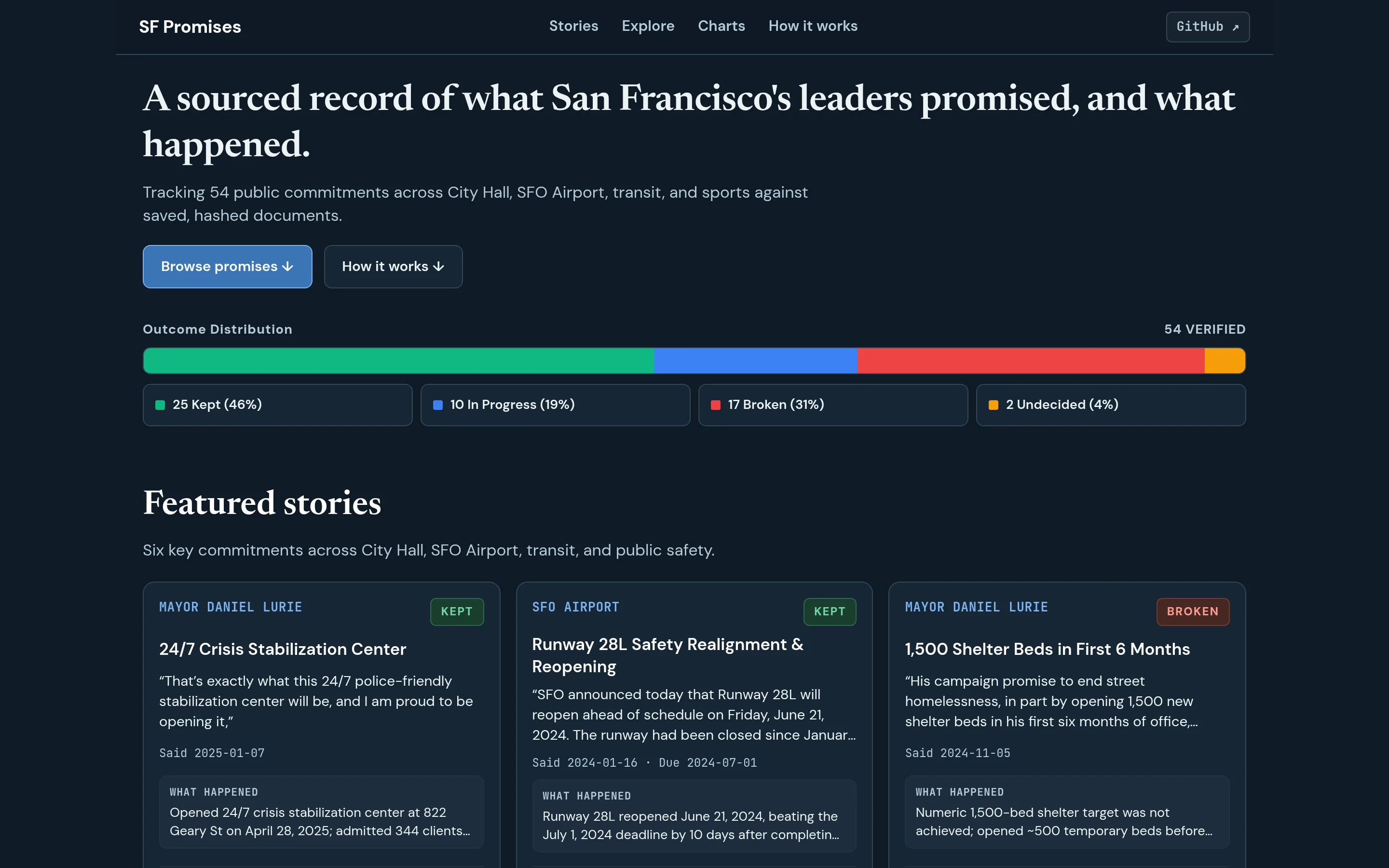
Across the current dataset, the pipeline produced:
- 54 tracked promises across City Hall, SFO Airport, regional transit, sports, and tech:
- 25 kept
- 10 in progress
- 17 broken
- 2 undecided
- 13 quarantined items caught by deterministic checks before reaching the public tables
- 100% agreement against a 25-promise hand-labeled gold set
- 0.0% false-accept rate across 50 automated adversarial mutations: mutated quotes and doctored claims were rejected before publication
For example: Mayor Daniel Lurie's promise to open a 24/7 crisis stabilization center at 822 Geary Street resolved as kept after the facility opened on April 28, 2025. Conversely, the pledge to add 1,500 shelter beds in six months resolved as broken. Every verdict links directly to its archived source so you can verify the trail yourself.
Stack
- Archil sandboxes and shared disks host the working SQLite database and archived sources
- Native SQLite for the promise, verdict, and verification records
- Keenable for search and fetch of official sources
- Nebius and Meta models handle extraction and advocacy; the verdict logic is pure code
Explore the Data
- Live demo: arii.github.io/sf-promises serves the full verdict board, quarantine registry, and per-promise verification trail
- Hugging Face dataset: huggingface.co/datasets/onasafari/sf-promises
- Source code: github.com/arii/sf-promises